On Book Reviewing

The essence of a competent book review, to me, gives a spoiler-free plot summary, a sense of what the author was attempting to accomplish, and addresses the literary technique and method the author employs. Thematic and subtextual analysis is an added bonus, as is contextualizing the work in the wider genre or literary landscape. I have read reviews of books (and other assorted media) where the reviewer absolutely hated the work they were reviewing, but they did such an excellent job of describing the work, that I bought the book/cd/saw the movie. I am not a fan of the “hatchet job,” though there are exceptions.(I often find that “hatchet jobs” are the result of lazy reading or are more about the reviewer than the work in question). The best reviews summon, to quote Barthes, “the pleasure of the text.”most-beautiful-libraries-24

BOOK REVIEW: Saffron and Brimstone by Elizabeth Hand. The post-punk Shirley Jackson

Imagine a postpunk Shirley Jackson, and you have Elizabeth Hand. Like Jackson’s oeuvre, Hand’s stories are heavy on atmosphere and the supernatural occurrences have psychological underpinnings. Her characters are outsiders, artists and damaged people, and when they don’t live in isolation, they live at the periphery of society, in various subcultures.

saffron and brimstone

The opening “Cleopatra Brimstone,” the most conventional `horror’ story here, sets the template. A plain Jane science geek girl gets sexually molested, which starts a transformation in her. Mousy Jane moves to London, gets a job at the London Zoo categorizing butterflies during the day, and becomes the glamorous Goth minx Cleopatra Brimstone at night. Cleopatra has a seductive, mysterious power that Jane doesn’t have that ultimately seals her fate. The climax of the story is morally disturbing, rather than visceral. The writing is lush and richly descriptive, and Hand’s attention to realistic detail anchors her tale.

Several pieces here are clearly autobiographical: “Pavane for a Prince of the Air” is about the death of a hippie shaman and has vague allusions to magic, but is mostly an ode to an odd, beloved free-spirit. “Wonderwall,” set in early 80s DC, is Hand’s eulogy for both her wayward youth and her artistic muse, here portrayed as a queer actor and his alter ego, who succumbs to AIDS. `Calypso in Berlin’ is an effectively creepy monologue about the titular muse making her way in the modern artscene.

Lovers of literary fantasy and modern gothic fiction would do well to check this handsome collection out. Four of the stories appeared in a limited edition volume called “Bibliomancy,” which means `book magic.’ Bibliomancy is precisely what Hand does with her craft.

Queer Weird Fiction: Samuel R. Delany’s Dhalgren

I first encountered the work of Science Fiction Grandmaster Samuel R. Delany (1942 – ) when I was in my late teens. When my older brother left for college, he left behind a copy of Dhalgren. You know that classic Bantam Edition, the one with the ruined city and the swollen and sickly orange sun. I read the book over a summer, enthralled with the topnotch phantasmorgia, the alternative sexuality and, perhaps most of all, the dream-logic poetic prose. Bellona is as vivid and haunting a creation as Mieville’s Bas Lag or Ashton Smith’s Zothique. The journey of the poet through a kind of underworld-like city has strong resonances with the Orpheus myth. That book, a masterpiece of liminal fiction, bridges the gap between “low” speculative fiction and “high” post-modern literature; between pornography and art; between prose and poetry. I maintain that Dhalgren is one of the key works in my personal cannon.

dhalgren

Years later, when I found out that Chip Delany was going to teach at UMass-Amherst), which was a part of the 5-College Consortium (I went to Hampshire), I jumped at the chance to take his class, which was about Comparative Literature. I remember we read The Man Without Qualities by  Musil and Death Comes for the Archbishop by Cather. I can’t recall much of the class, but I remember with fondness the times I met with Chip during his office hours, and spending the time chatting about Science Fiction and writing.


Queer Weird Fiction: Joe Orton’s Head To Toe, a camp surrealist fantasia

British writer Joe Orton is famous for his blackly comic plays and and for the tragic manner of his death: being bludgeoned to death by his lover with a hammer. He is less well-known for his fiction. He published one novel, Head to Toe, a brilliant piece of Weird Fiction that languishes in obscurity. I say it’s brilliant, but your mileage may vary. The novel is set on the body of a giant being (referred to as an afreet) and concerns the wild adventures experienced by an ordinary schlub who wanders up on the creature’s body, finding that entire societies live there. The humor is Swiftean farce, but the underlying mood is one of Kafkaesque anomie. The text is marred by some archiac misogyny and the plot is episodic. It still manages to be haunting, full of dream logic. In a way, it’s like an adult, very camp and very queer Alice in Wonderland kind of phantasmorgia.

Head to Toe

On Transphobia: A Tale of Slurs and Privilege


RuPaul’s Drag Race has been criticized for using certain terms that are considered harmful for the transgender community. The segment “You’ve Got She-Mail” has been removed from the show, and more recently, RuPaul doubled down on the use of the word “Tranny.” Rather than dialoguing about the usage of the terms, RuPaul has descended into the tiresome “PC Fascist” argument, claiming that his critics are “Orwellian.” It’s an unfortunately defensive response.

I understand that the issue is complex. Drag Queens, for instance, actually are “she-males,” and (I can see the empowerment in co-opting a damaging term), whereas transwomen have fought long and hard for their gender identity and calling them “she-males” completely devalues their struggle. The same can be said of “tranny”: it overlaps with the term transvestite. But to victims of transphobic violence, that word takes on a dark, hate-filled meaning. In one of his tweets, RuPaul says, “It’s not the word itself, but the intention behind the word.” In other words, transfolk are just too sensitive! Intention is not magical

This is an example of privilege  is caused by a lack empathy. This lack of empathy is one of my greatest pet peeves. It reminds me of when people use the phrase, “That’s so gay” and immediately become defensive: “I don’t mean it that way! I have gay friends!” (They don’t intend to insult gay people, but saying, “That’s So gay” is so entrenched in everyday vernacular). I am immediately transported back to my 20s, when I was the victim of a physical assault motivated by hatred. “That’s So Gay” was no longer an abstract turn of phrase; the implied negativity had transformed into a life-threatening act.

I am not angry at RuPaul for not getting this point. I am deeply saddened.


Why Dark Fiction?


I actually don’t think I write horror, as in flesh-eating zombies or vampires or splatter punk. I tend towards dark fantasy or ‘weird’ fiction. But there is a definite darkness in what I write. And the forthcoming collection (not to mention the eBook series, Variations) has at least one piece that could be considered straightforward horror.  Someone always asks me why I write what I write. Why so dark, so pessimistic?

Part of me wants to use the ‘channelling voices’ excuse: that the characters  just sort of use me as a vessel to tell their stories. And I think every writer has a moment when they feel that: Where did that come from? But if I am channelling voices, why are they such sad, and at times, disturbed voices?
Exorcist_steps

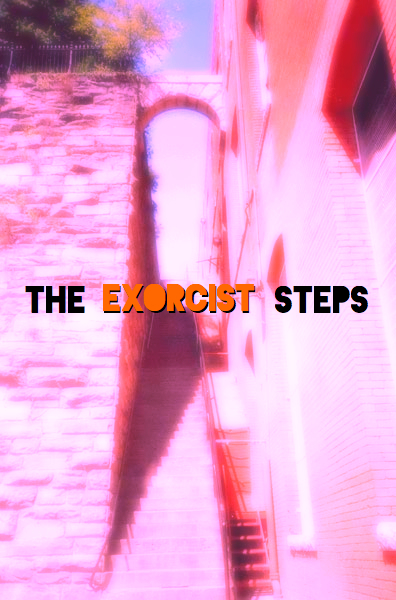
A large part of me being drawn to dark fiction is, of course, I grew up on horror. I macerated in it.  I live in DC, where the movie The Exorcist took place, and the true story that inspired it happened in just-across-the-border Mount Rainer. It was a young rite of passage to visit the terrifyingly rickety Exorcist steps in Georgetown. Stephen King burst on the scene in my childhood. I remember, vividly, those lurid covers from the 70s. Cryptozoology was serious business. I used to devour books documenting the existence of Bigfoot, the Yeti, the Jersey Devil, and nearby Maryland’s own ominous Goatman. I even had an aunt who told me her creepily prophetic dreams. Summers we went to Atlantic City where, at the time, there was still a freakshow that featured a fearsome Ape Girl who would escape and bum rush the audience.

Or maybe it’s something more. I learned pretty young that the world is a terrible place, full of disease, torture and worse. I think I write dark fiction and about dark subjects because its cathartic, and helps me work through the fear and anger I have. The ‘voice’ I am channelling is my own subconscious. I contend, in my own fiction, the real world horrors my characters face are often worse than any supernatural demon.