Confounding Stereotypes: Adventures in Fandom and Microaggression

A Buzzfeed article, 21 Microaggressons You Hear on a Daily Basis, has been passed around my Facebook feed. One particular sign really resonated with me.
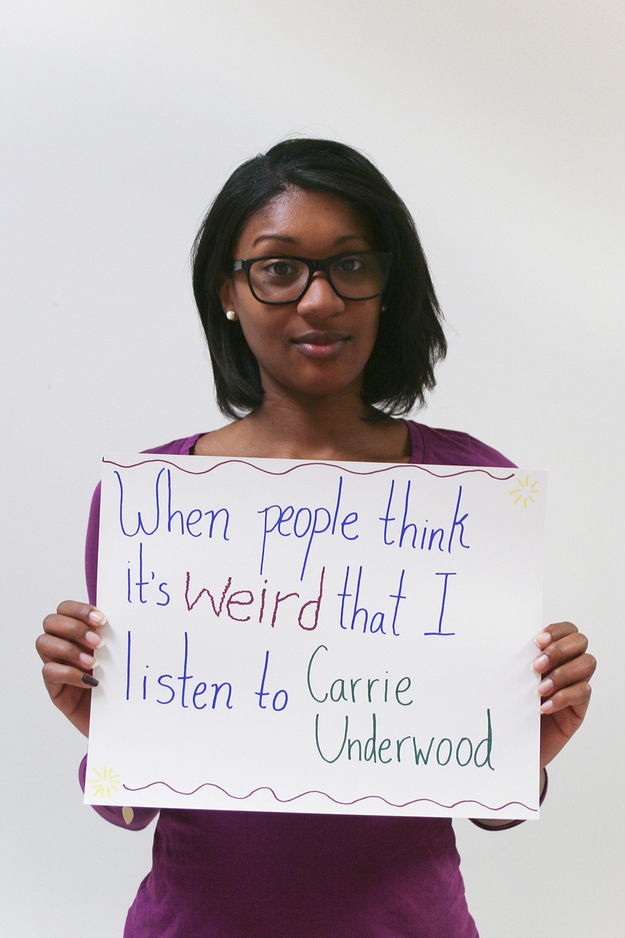
Carrie Underwood Fan

No, I don’t listen to Carrie Underwood.  But….I like ‘white’ music. Particularly alternative, gothic and indie music. So I feel this girl’s pain.

I remember when I haunted a record store in college, always looking for an interesting album.  Before the Internet, buying music was a bit of a gamble. You had to rely on record reviews, the label that the album was on, and occasionally, the artwork to give you clues to what the music sounded like. So visiting a record store was often a 2 hour ordeal that included much research and contemplation. The staff of this particular record store was used to me, (and many other college students) spending hours among their stacks. However, one Saturday, there was a new staff member who rather overzealously followed me and repeatedly asked me if I needed help. She ignored the other customers, and focused on me with a laser-like precision. Eventually, I left the store, and didn’t return until the spring. I was familiar with this kind of micro aggression. It was a combination of Shopping While Black with a liberal dash of This Isn’t Your Type of Music!

I was relatively lucky before that point. I grew up in an area where it wasn’t uncommon to see PoC at punk and indie shows. Every now and then, someone would glance at me sideways, but that was the extent of it. But that Othering was uncomfortable enough to make me avoid that particular shop. When I returned to the shop, the overzealous employee had left. Maybe someone else complained about her.

Frankly, this incident was small potatoes compared to what I experienced on an online forum circa 1998, when the Internet etiquette had not yet been established. The goth singer Siouxsie Sioux had started a side project with  fellow Banshees drummer/husband Budgie, called The Creatures, which she released independently.  The Creatures had an active and lively online forum, which I joined. In the ‘intro’ section of the website, I wrote something like, “Hi, I’m Craig…Just wondering if there are any other Siouxsie/Creatures fans of color.”

Reader, you would have thought that I had insulted everyone’s mother and desecrated a thousand graves. Message after message condemned me for even mentioning race. I was a racist of the worst kind; I was like Louis Farrakhan; I hated white people etc.  And those were the intelligible responses. I quit that den of obnoxiousness quickly, never to return.

A few years later, I went to hear the world music/goth crossover band Dead Can Dance in concert. I ran into an acquaintance at the concert.

Him: “What are you doing here? Black people don’t like Dead Can Dance!”
Me: Throws Shade and eye-rolls so hard that my eyes fall out and roll down the hall.

I’ve been confounding stereotypes since the 80s, and I have no intention of stopping.

BOOK REVIEW: Big Machine by Victor Lavalle. A secret society of unlikely scholars and Afrogeeks

Big MachineBig Machine by Victor LaValle

My rating: 4 of 5 stars

Big Machine by Victor Lavalle is an ambitious horror novel about secret societies with subtextual issues about race and class that is full of laugh aloud moments. It’s a sort of tonal patchwork of A Confederacy of Dunces, The DaVinci Code and The Intuitionist.

Ricky Rice is a bus station janitor who receives a mysterious summons to someplace in remote Vermont. Because he’s an itinerant ex-junky, he uses the free bus ticket and arrives at the Washburn Library along with other African Americans misfits and petty criminals who all seem to have turning points of Epiphany buried deep in their checkered pasts. They are branded collectively as the Unlikely Scholars and charged with collecting and cataloging reports of esoteric phenomena. After a period lasting perhaps a year, Rice manages to crack the code, and is sent on a quest to Northern California to track down a heretical Unlikely Scholar.

The wild plot, full of incident and conspiracy and supernatural occurrences is as expertly paced as a Stephen King novel. But it was the narration and characters that kept me glued. Rice tells his story in the first person, full of quips and asides about lower class African American life that ring true. The repartee between Rice and his partner the Gray Lady (aka Adele Henry) zings like the best of Nick and Nora. The scenes of horror and degradation, both personal and environmental, are chilling. It’s a pleasure to read this kind of fiction with such well-realized characters that you don’t often see on the printed page.

Ultimately, I don’t think Big Machine succeeds as well as Lavalle’s most recent novel, The Devil in Silver. The ambition and scope of the plot gets the better of him. But it’s a fun ride, full of beautiful writing.

View all my reviews

CONCERT REVIEW: Anna Von Hausswollf at the Atlas Theater, 12.4.13

Ceremony
Ceremony

Last night I saw Swedish composer and multi-instrumentalist Anna Von Hausswolff in concert at the Atlas Theater in Washington, DC. She mostly accompanied herself on the organ, and along with her three-piece band (guitar, drums and synthesizer) crafted complex post rock soundscapes that drew from folk, liturgical and progressive metal musics. At times, it sounded like Nico fronting Sigur Ros. But the Nico comparison only counts for Hausswolff’s use of the organ (Nico played the harmonium). Hausswolff’s voice has more range; she can sing operatically or wail like a post-punk banshee, sometimes in the same song. The setlist included most of her album Ceremony; at least two of the songs were dense, funereal instrumentals. Most of the time, Hausswolff sat behind her organ and head-thrashed along to the music, an arresting visual, given her extremely long blonde hair. She stood up on two songs, respectively playing the acoustic guitar and tambourine. With her all black velvet dress and long hair, she looked like Stevie Nicks circa 1976. If you like gothic/experimental/ethereal music, be sure to check her out. Recommend for fans of Nico, Dead Can Dance, and Sigur Ros.

On Diversity & Dogwhistles

A couple of years ago, the online zine Expanded Horizons published a short piece of fiction that I’m immensely proud of, entitled “Conjuring Shadows.” The story is about a transgender conjure-woman in the Harlem Renaissance.  Expanded Horizon’s mission statement is this:

The mission of this webzine is to increase diversity in the field of speculative fiction, both in the authors who contribute and in the perspectives presented. We feature speculative fiction stories and artwork, as well as essays about speculative fiction and fandom from diverse points of view.

So that is my dog in the current fight.

I hate drama. I really, really do. It’s toxic to me. I don’t like confrontation. But there are times when you have to take a stand. Every now and then in the speculative fiction world, some person will write an article about how Diversity/Political Correctness etc. is horrible. They think they’re taking a stand against didactic Aesop-styled fiction. What they are really doing is dog-whistling, save that the dog-whistle is as loud as a klaxon.

What I, and other minorities hear is: “You don’t write good fiction,” or “Why are black/gay/feminist/trans people harshing my squee?” Is it any wonder that POC don’t go to cons? I’ve pretty much stopped going to cons BECAUSE of the lack of diversity. And I don’t think I’m the only one who feels that way. THAT is the effect of these jeremiads.

MUSIC REVIEW: ‘Nights Bright Lights’ by Chloe March. For fans of David Sylvian, Colleen and Goldfrapp

All days are nights to see till I see thee,
And nights bright days when dreams do show thee me.
—“Sonnet 43,” Shakespeare

Ah, the Concept Album, that hoary idea that birthed such dubious masterpieces as Evita and “Mr. Roboto.” Chloe March’s third album loosely fits in this category. But you won’t find an overarching narrative theme. Instead, you’ll find a suite of songs that use image-patterns of night, winter, light, dark with a sub-theme of Orpheus and Eurydiche running through three compositions. And I use the term ‘composition’ deliberately, for these amalgamations of synthesized programs, with delicate colorings of piano, saxophone, zither and guitar are closer to the work of Erik Satie than they are to traditional pop music. March’s work most recalls David Sylvian’s classic album, Secrets of the Beehive, with its slow burning atmospherics that borrow from folk, classical, jazz and electronic ambient music. Her smoky velvet alto also shares Sylvian’s ruminative phrasing. The use of zithers (in this case, autoharp and psaltery) at times recalls the hermetic, textural compositions of acoustic-ambient artist Colleen. Nights Bright Days is like musical incense. Recommended for fans of Sylvian, Virginia Astley, and Goldfrapp (in the vein of Felt Mountain or Tales of Us).

Nights Bright Days