
I made new covers for my flash fiction compositions over on Wattpad..

I don’t like talking about negative private things. This author blog primarily exists to share and discuss fiction–both my own and others–and has expanded into mini-essays about racism and my health. Those outlier essays are still connected thematically to the core focus, because my fiction often addresses these issues.
This post, however, will be more direct. Certain health issues have reach a critical mass with me. I suffer from Samter’s Triad, which includes nasal polyps. Last year, I confirmed that the polyps, which had been removed surgically 5 years prior, are back. This means: no since of smell (addressed in an earlier post) and constant sinus headaches. These past weeks, I have developed yet another side effect: almost everything I taste now has a weird metallic taste. I have noticed that I have lost some weight, because eating is not pleasurable. I’ve also noticed almost everyday I have a headache and pop ibuprofen like candy.
I think I need to see a doctor.
I have no insurance, so I can’t access a healthcare network.
I am requesting some help—in the form of ideas who I should turn to get some some professional help. Additionally, I could use some emotional support as well. Just someone to talk to. That’s all.
If you are so inclined, you may contact me at clgidney@gmail.com


In the past, I have found Barwick’s vocal-based ambient music too wispy. A Barwick album is mostly made out of layers of her vocals that mass and drift along like dandelion seeds. It’s admirable, in the way looking at a frozen lake is. But it’s too insubstantial. For whatever reason, Nepenthe has grabbed me. There’s more structure to her work this time. And rather than just being ‘celestial,’ there is a definite atmosphere to each of the compositions–something darker and more pensive. It holds together as an album. It’s still chilly and wispy, but the melodies are stronger.The song One Half is even catchy, and has words. Nepenthe is closer in spirit to Sigur Ros than it is to Enya.

The first H.P. Lovecraft story I read was “The Outsider.” It was, and still is, a fine piece of work. It’s a poetic tale about an introvert who touches a dark “eidolon,” drinks the elixir of “nepenthe” and then joins the ghastly beings who live in the nooks and crannies of time and space. “The Outsiders” is, in addition to a horror story, a mediation on isolation and loneliness. As a closeted student in a mostly white high school, I felt like an outsider myself, and wanted to ride with the ghouls in the chilly, beautiful vistas of other dimensions.
Then I read the next story in the collection, “The Rats in the Walls.” I never finished it, because the narrator had a cat, called “Niggerman.” I have never read any other Lovecraft afterwards. I later found out that Lovecraft was a racist and anti-semite of the highest order, who subscribed to the pseudoscience of eugenics. Lovecraft wrote a poem that is practically talismanic for the White Supremacist crowd, called “On the Creation of Niggers.” Black people, like myself, are described in other stories as being bestial and like gorillas. Apologists will say that Lovecraft was a product of his time. To which I say, no. There were white progressives back then, and white people who even married black people.
I came back to “The Outsiders,” years later, and realized that there is an allegory there. Lovecraft, like the narrator of the story, lived alone in a castle of fear and hatred. He only found kinship with the ghouls and shades in an alternate universe. And what are racists, except ghouls and shades that hide out in some alternate universe where non-whites are subhuman? White Supremacy is the ultimate nepenthe.
*There is a character in the New Scooby Doo Adventures named H.P. Hatecraft.
I have lost my sense of smell.
In someways, this is good. Unpleasant odors no longer assault me. Public bathrooms and the cat’s litter-box are no longer challenging.
But it’s mostly bad. Most of taste is smell, so the finer gradients of flavor are lost on me. I can taste sweet, sour, spicy and salty. But nothing more complex than that. Food tastes beige and bland. Earlier this week, I ate some salted caramel ice cream. The wonderful taste of burnt sugar was lost on me. It was just milky and creamy. My favorite dish in the world—an onion and blue cheese tart—is no longer ecstatic. There is the ghost of flavor, but it has no depth.
My lack of smell and taste is due to a chronic condition I have. It’s sometimes called Samter’s Triad or Aspirin-Induced Asthma. The “triad” is: one part allergy to aspirin, one part asthma, and nasal polyps. The polyps are non-cancerous tear-shaped growths that bloom in sinus cavities. They block scent receptors. In addition to the lack of scent and taste, I get sinus headaches, always sound stuffed up, and worst of all, get frequent sinus infections, mostly due to the build up of fluids trapped in the sinus cavities.
I had an acute asthmatic attack one time in Brooklyn about 10 years ago, after I’d taken an aspirin. I was rushed to the emergency room, where I was given oxygen and had numerous tests done on me (that insurance did not cover). Until then, I had never been diagnosed with asthma, but looking back over the years, I realize that I had a slight case. About five years ago, I had an operation to remove the polyps. In preparation, I had to take prednisone, which made me manic. It took about a week to recover from surgery, and lots of vicodin.
Now, the polyps are back, and all of the attendant issues. This week has been the worst of it. I’ve been having extra wheezy days, along with headaches, and at times it’s comfortable to even talk.
More than smell and taste, I miss the just feeling normal. My head is full of pressure and tightness, like a balloon ready to pop.

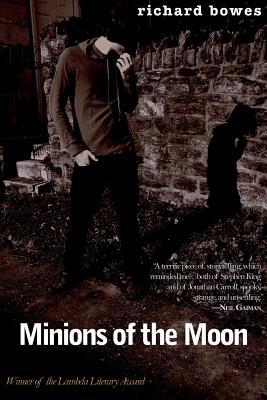
Lethe Press has reprinted one of the seminal works of Queer Fantastika (magical realist/weird fictional texts with LGBT content). Don’t miss an opportunity to read this.
Kevin Grierson comes from an Irish-American family that’s cursed by violence, booze and shadows. The Shadows, in this case, are real quasi-people who embody all of the worst instincts and impulses that a person can have. They are like the Id, given substance. In Grierson’s case, his Shadow pushes him into drug and sexual addiction and the petty crime that goes along with that lifestyle. The novel, told in a series of vivid flashbacks, starts in the late 40’s, in Boston and ends in the 90’s in New York’s West Village.
A strange coming of age story told in first person, Minions takes us on Kevin’s journey as he struggles to find out where he and his Shadow are separate entities. On one hand, the doppelganger drags him closer to hell and failure; on the other, the Shadow is streetwise and savvy and saves Kevin in more than one instance. Kevin and his Shadow exist in any uneasy balance with each other. They move from tragedies, failed relationships (with both men and women), and dangerous situations together, helping each other out in a sick, co-dependent-yet oddly comforting way.
.The scenes of sexual degradation and drug dementia are chilling and horrific in their accuracy. It’s part of what makes this a horror novel-the all-too real world of chemical dependency. As disturbing as these scenes are, they are what keeps this novel edge-of-seat reading. Bowes’ voice (as Kevin) is so real that at times I thought I was reading an autobiography. This is because Bowes makes us care about Kevin, even when he does horrible things. We’re with him when he finds love and transcendence, as well as with him down in gutter, looking up towards the stars.
The fantastic element is skillfully woven into the story. The mechanics of the Shadow are never properly explained-a vague telepathic awareness of each other when they’re split up is alluded to, never elucidated. The characters that enter Kevin’s life walk and breathe on the page, even if they appear for only a couple of scenes.The locales, particularly the seamy underside of New York, seem to be characters themselves.
Minions on the Moon is one of those novels that completely transcends the genre for which it was marketed. It is a stunning examination of identity and the search for meaning when you’re under the influence of various addictions and self-destructive behaviors.
 Tours of the Black Clock by Steve Erickson
My rating: 5 of 5 stars
Steve Erickson claims kinship with authors Philip K. Dick and Thomas Pynchon, and its easily to see why. Like those authors, he subtly twists the nature of reality and history until it resembles the inner (both philosophical and psychological) landscapes of his characters. This novel is about white-haired Marc and his mother, who live on a small island in the middle of a fog-shrouded river in the Pacific Northwest. They have an estranged relationship with each other, stemming from the fact that Marc doesn’t know who his father is, and his mother will not speak to him about her past. One day, he comes home and finds her with a dead man at her feet. The image so disturbs him that he will not set foot on the island for about 20 years. He takes over the ferry that shuttles tourists back and forth. He finally goes back to the hotel where his mother lives, in search of a mysterious girl who has not stepped back onto the return ferry to the mainland, and runs into his mother. The ghost of the dead man is still at her feet, and he tells both mother and son of his strange history.
Banning Jainlight was the bastard son of a farmer and his Native American slave mistress in the earlier part of the century. He ends up burning down the farm, killing one of his half-brothers, and crippling both his father and his step-mother for the cruelty they inflicted on him. He runs away to New York City, and several years later, ends up in Vienna, Austria, where he writes pornography for a powerful client in the newly ascendant Nazi Regime. He bases his writings on the strange, surreal sexual encounters he has with a young woman who lives across the street from him. In his writings, he transforms her features and her name to resemble those of the client’s — who is, of course, Hitler — long lost love. Bear in mind, that this is just a brief description of this novel.
Jainlight’s story sparks off the no-less compelling story of Marc’s mother, that moves from pre-Revolutionary Russia, sub-Saharan Africa, and Post-war New York City. Moving across dreams and reality, fantasy and history, this dense novel weaves together such unlikely themes as relationships between lovers and parents; the nature of good and evil; and the quest for identity. The images and instance in this novel are numerous and unforgettable: a woman who can kill men with the wild beauty of her dancing and menstruates flower petals; a city that’s in the middle of a lagoon, and covered by blue tarps; a burial ceremony where the dead are hung upside-down on trees until they can speak their names; a herd of silver buffalo who run through the plains of Africa and North America. The writing is lovely and lyrical.
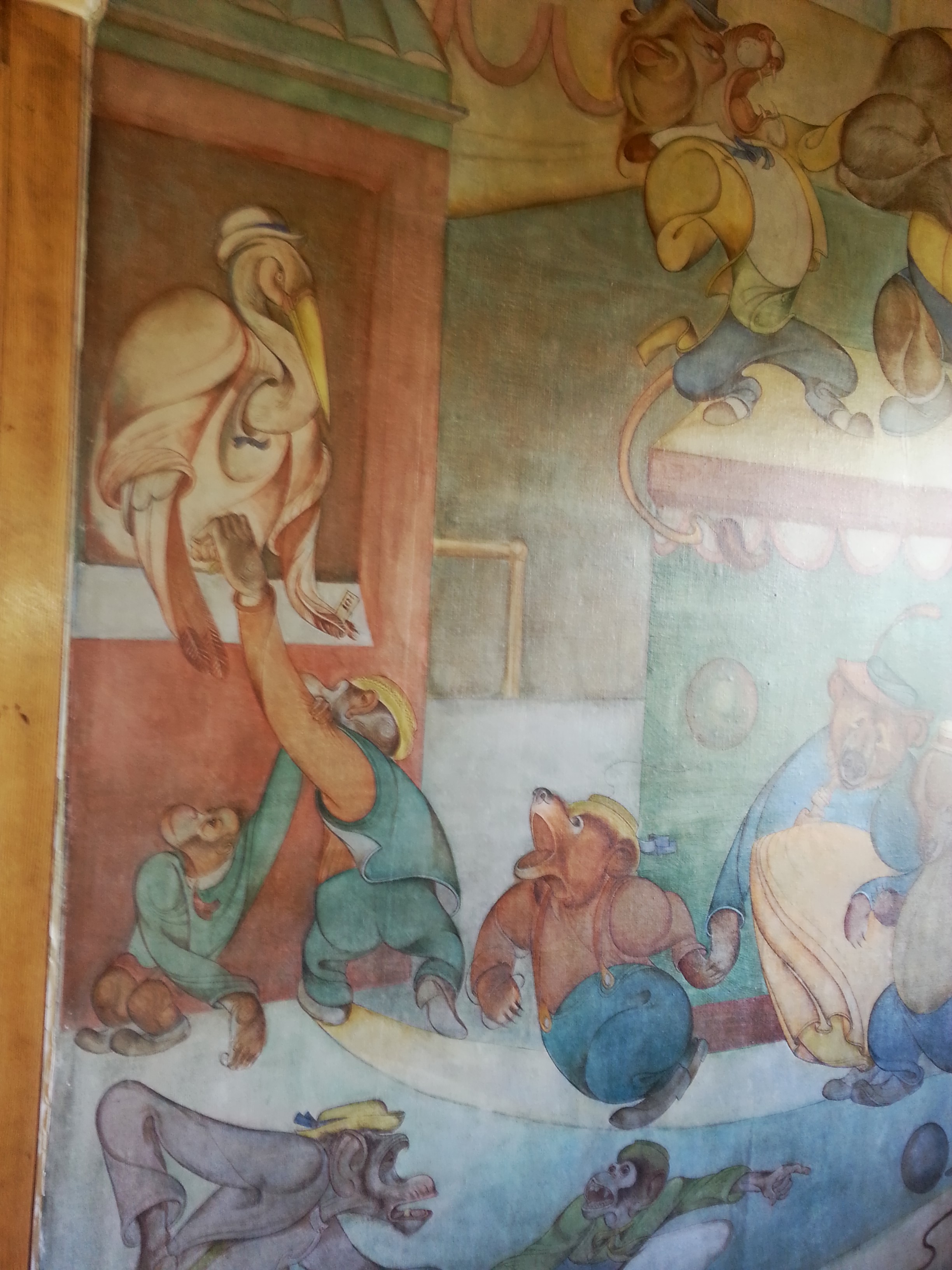
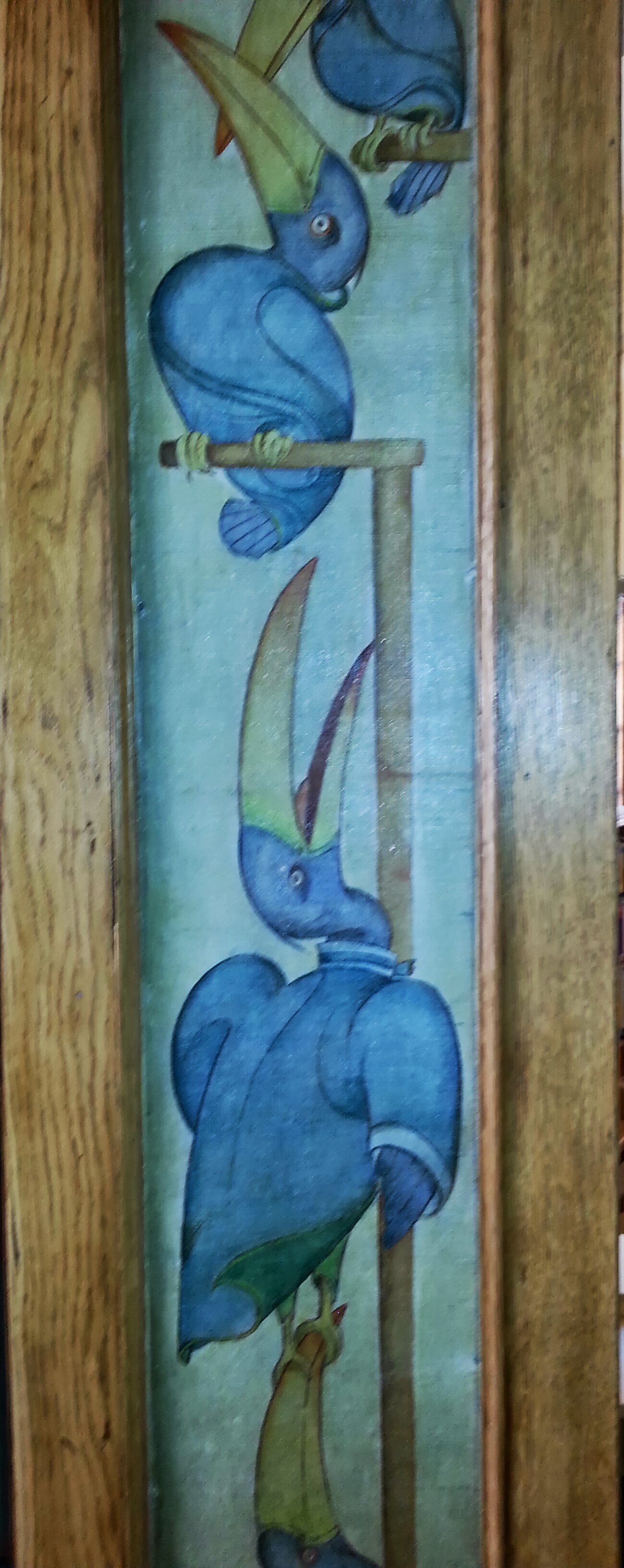


Last night I learned that my neighborhood library, the Mount Pleasant Branch of the DC Public Library system, has a mural in the children’s section painted by Aurelius Battaglia. He was an illustrator who went on to work for Disney. His animation can be seen in Dumbo, Pinocchio and Fantasia. The mural has been preserved, and the library is going to put some of his illustrations on one of the bridge-walkways in the building. Above are some pictures I took of his work.
Tanith Lee just won a World Fantasy Lifetime Achievement Award, which is well-deserved. At her best, her prose and storytelling ability have an almost supernatural intensity. She has also been tremendously supportive of my own writing. As a congratulatory measure, I am reprinting some reviews of her fiction, in the hopes that more people will buy her work. This book is still in print!
My rating: 4 of 5 stars
Lee has begun another series of novels, linked together by the alternate city Venice, called Venus, arranged around the 4 elements essential to alchemy. Book 2 is set in medieval Ve Nera, popularly called Venus by its citizens. This ‘Venus’ is ruled by the Council of the Lamb, a group of priests who use terror and taxes to keep the citizens in line. The Duke of the city is only a figurehead. The Church traffics in brimstone and fire imagery, and hangs sinners in cages as examples. Like many dictatorships, some people are not so lucky to be made examples; they just disappear. Of course, not everyone agrees with these policies. Danielus is a high-ranking priest who despises the Council, both in tactics and theological interpretation. Only his rank, and control over the Belletae Christi (Soldiers of God) keep him safe. But he has to publicly support the Council, and clandestinely undermine their work. The Council’s latest endeavor is a trade war with the Moslem city of Jurneia, which they cloak ideologically as a Holy War against infidels. This war is ill-considered, due to lack of monetary funds and the greater military naval might of the Jurnieans. When in the city, tales of a strange girl who can turn her hair into fire, start to circulate, Danielus investigates and finds that it is true. He begins the process of grooming her to be a Joan of Arc emblem for the demoralized and terrified city.
While Lee does focus on the plight of the girl, whose name is Volpa (Italian for fox) and is transformed into the genderless Beatifica the Maiden, the story is really about Danielus and his radical (ecumenical) theology. The Maiden is a cipher for the people, existing in a aloof world of dreams and disappointing reality. Volpa is a simpleton, with a talent for elocution and mimicry, in addition to her fire-magic. Her magic seems to be inspired by the emotions of people around her, as if she is a magnifying glass for the human soul. Is she an angel, striking spiritual fire, or Danielus’ puppet? Is she being exploited? Lee doesn’t have easy answers for these questions, leaving it up to the reader to decide.
In addition to her trademark poetic, prose, Lee has valid political and philosophical subtexts. Venus is the goddess of sexual love. The Council of Lamb, like many fundamentalist Christian theologists, posit that sexual desire, outside of narrow confines, is essentially sinful. Lee turns that religious notion on its head, revealing the dangers and limitations of those beliefs. Saint Fire is a clever, original adaptation of the Joan of Arc story.
 Swift, Brutal Retaliation by Meghan McCarron
My rating: 5 of 5 stars
This is a ghost story, but done as a realistic family drama. Think Cheever or Franzen rather than Shirley Jackson or Stephen King. The ‘horror’ is the disintraging relationships. The emotional brutality and unrelenting prose probably what placed this story on this year’s World Fantasy Award ballot.


 Craig Laurance Gidney
You must be logged in to post a comment.