The cover of the new Glasser release, Interiors, shows frontwoman/conceptualist Cameron Meslrow dancing in a reflective sea of liquid metal. She appears to be molding it into a shape, even as she is being distorted. It’s an appropriate image for the music within. The music is meticulously crafted on computers, full of sound effects that beep, whir, burble, and whoosh; it embraces its artificiality. Meslrow sings the body electric over these dynamic mechanical compositions with a high, girlish voice that somehow manages to be detached and vulnerable at the same time. Song titles center around processes or shapes: “Dissect,” “Divide,” “Window,” “Forge,” “Landscape.” It sounds like a catalog for a minimalist art installation. The lyrics deal with abstract concepts, like isolation and the act of creating art. While there is a Laurie Anderson aspect to Meslrow’s delivery (the icy detachment) her melodies and the rhythms are catchy. Interiors bridges the gulf between high concept art and ear candy. Glasser makes art pop that’s actually fun.
If the American spirit were to be personified, she wouldn’t look like Lady Liberty. She would be a woman of color with scars on her flesh, calligraphic tattoos of pain and suffering. All of the progress and expansion of the U.S. has been gained through the genocide of the indigenous population and slavery. (Not to mention the initial hazing period that many immigrants still go through). This sordid history is sometimes hidden or romanticized. When I was a student at a mostly white high school, I distinctly remember my 10th grade history teacher made a point that some masters loved their slaves and treated them like family. Mind you, I was not militant back then. Far from it. But I knew that I was being feed a line. I recall thinking to myself, why does she want to believe that so damn much? This desire to turn the matter of slavery into a Gone With the Wind fantasy of crinoline hoop skirts, palatial mansions and sassy, loyal mammies most recently surfaced during the Paula Deen affair.
Yesterday, I saw Twelve Years a Slave with my mother. That movie should be required viewing for all Americans. The scenes of torture are beyond horrifying. They are soul-destroying. I found myself wishing that the black characters would all commit mass suicide. The movie goes beyond the whippings and dehumanization. It illustrates the mindset and the methods to bolster the Peculiar Institution. The enslaved had to be constantly terrorized and believe that their lives were expendable in order to maintain the status quo. The beatings in this film are relentless and graphic. Solomon Northup encounters two masters during his enslavement. The ‘kind’ master simply lets his overseers do his dirty work. In the end, Northup is sold to the ‘bad’ master, who has a more hands-on approach. Both masters are nominally Christian, with the second one given to bouts of religious mania, even as he abuses his ‘property.’ The mistress of the house wears outfits to rival Scarlett O’Hara’s, sumptuous gowns of silk, velvet and lace. But beneath the surface trappings of grace, she has a sadistic streak. Black people were things, beasts of burden to these ‘people.’
I finally saw the horror movie The Conjuring this week. It had all of the things I love about good horror movie.
▪ Atmospheric
▪ Slow build with lots of plausible deniability
▪ The handsome Patrick Wilson
▪ The brilliant Lili Taylor (whom I sat near in RL in a restaurant; ask me about it sometime)
Like Sinister and Insidious, The Conjuring proves that you can scare people with a minimum of gore. I hate violent and slasher films. I can’t watch torture porn, like the Saw and Hostel franchises.
My main criticism with the movie is with the third act, when the mystery is revealed. I actually think it would have been scarier if the line between actual possession and mental disturbance was blurred. We all have dark, atavistic urges and voices hidden deep within our brains.
Annabel doll
One of the tropes that The Conjuring (and Insidious and Sinister) keep returning to is the idea of possession. An exorcism is the dramatic denouement of most of these films. When I was a child, I couldn’t bear to watch the mother of all demonic possession films, The Exorcist. An innocent person taken over by an evil entity doesn’t really terrify me, per se. And the staples of possession: ravaged, tortured voices, blasphemous oaths, levitation and puking don’t bother me, either. What scared me as child, and still scares me, it what happens to the possessed spirit. Insidious is the only movie I know of that explored the limbo where the ensnared soul was housed.
I am also disturbed with the whole Christian rites as being the only panacea against such evil. What happens if you get possessed and you’re an observant Jew, or are Buddhist, Hindu or Muslim? One of the subtexts of this subgenre is that Christianity is inherently good, something I don’t believe. In The Exorcist, the devil uses a pagan entity, Pazuzu, to get into Regan. According to Babylonian myth, Pazuzu, despite (or even because of) his scary appearance, could be used to drive away other evil spirits. This whole subtext of Christian hegemony kind of spoiled The Conjuring for me.
The 1980 novel KILL THE DEAD is a perfect introduction to Tanith Lee’s writing in the Gothic mode. The short novel has all of her hallmarks: two tortured Byronic anti-heroes, a beautiful witch antagonist and a plot that is full of twists that allude to and subvert literary tropes. The novel concerns the mordantly humored exorcist Parl Dro, and his dealings with a hapless musician and a vengeful female lich (an undead sorceress). The prose is lovely and musical, full of rich imagery that incorporates Tarot symbolism throughout the text. The dialogue is is full of quips and dry humor. Some of Lee’s best work is at the novella length, and KILL THE DEAD, reissued as an ebook by Immanion Press, is an excellent example.
The #DiversityInSFF hashtag gave a solid signal boost to the longstanding, often-ignored, ever-trolled, much-needed convos about race and gender, privilege and science fiction/fantasy that have been going on since the dawn of time. For a few weeks twitter was all aflame with debates, links and related shenanigans. We have these convos, increasingly in depth, at cons and across the blogosphere. Backlash against those who speak out has come in the form of death and rape threats, hate mail, doubling down on sexist/racist/homophobic/ableist material, and mind-numbingly nonsensical counterarguments. And, of course, comments sections. Still, we move forward, take breaks to recuperate and then move forward some more towards a vision of SF/F that isn’t just another white male savior fantasies, a diversity that’s more than fake smiling multicolored dress up dolls.
This month Rose Fox and I have been wrapping up the selection process for Long Hidden, an anthology of…
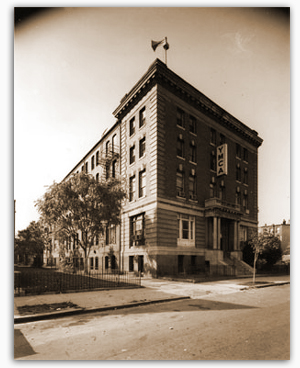
Last night I attended a panel discussion about racial discrimination in the DC gay bar scene, put together by the Rainbow History Project. (The discussion was held in the Thurgood Marshall Center, that had formerly served as the “Colored” YMCA back in the day; Langston Hughes used to room there).
Thurgood Marshall Center/ 12th Street YMCA
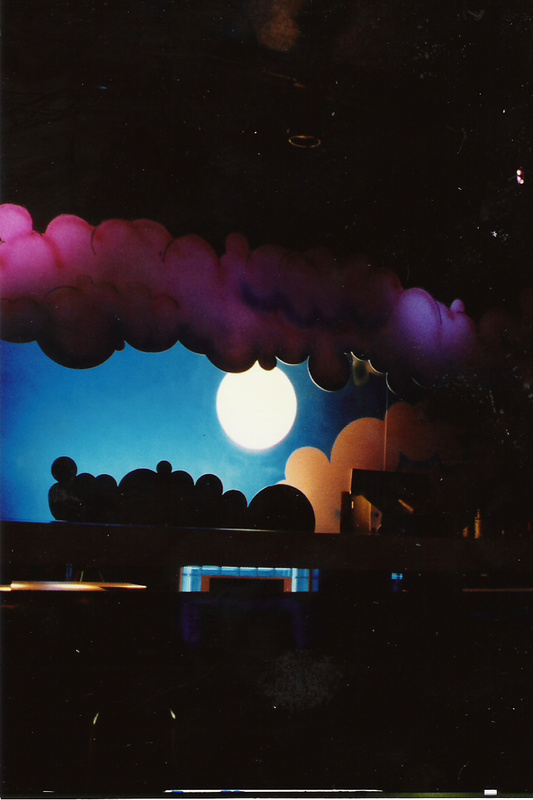
Many bars and clubs used the practice of “carding” to deny entrance to African-Americans, transgender people and women. “Carding” = demanding multiple forms of I.D. for one set of customers, while the desired demographic gets to enter with only one (driver’s license). One bar, the Lost and Found, was sued over this practice and the court testimony included bar employees recounting a staff meeting where they were instructed not to serve “n*ggers.” Another club, Badlands, reached a settlement after that accusation. Eventually a law was passed whereby drivers/ non-drivers licenses were the only required identifications needed to enter bars. Many of the panelists and the audience members also recounted their experiences in those days. One older gentleman said that he would be let in when accompanied by white friends, but would be denied entrance when he was in a group of fellow African Americans.
The inside of the Lost and Found, courtesy of the Rainbow History Project digital archives
A few years ago, I was on an online forum where a couple of white gay men were talking about how Black Pride festivals were “reverse racist.” When I brought up the issue of “carding,” they all vehemently denied the mere possibility of such a practice. Before leaving the forum, I posted a link to the article that showed that such things happen even today.
DC in the 80s was a hellish place. It was a city plagued by poverty, murder and the scourge of the Crack Epidemic. I was shipped off to high school in nearby Maryland during that time, where my mostly white and affluent classmates would marvel that I lived in the sordid mess that was the District. I remember one of my classmates even told me, quite snottily, that in the suburbs, “At least we have trees!” (Please note that my house was directly across from Rock Creek Park, and we would get routine visits from deer, possum, and raccoons). My older brother was shot in the late 80s, after being carjacked.
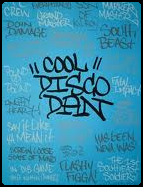
During those turbulent times, if you rode the Metro, you saw the graffiti tag Cool “Disco” Dan everywhere. On the buses, against the walls, on rooftops, under bridges. This mysterious artist’s (or vandal, depending on who you spoke to) signature appeared everywhere in the Metro Area. Who was this person?
The documentary The Legend of Cool “Disco” Dan examines the man behind the tag. Dan was a man who started tagging in his teen years, fueled both by his love of the indigenous Go Go scene and his own mental anguish. The film contextualized his avocation against the larger zeitgeist of the Reagan 80s, the Crack Epidemic, Go Go music and the heyday of Chocolate City. While not exactly agitprop, the emblematic logo was and still is a sign of times and of the DC that exists in the shadows of the federal government. Dan became a kind of folk hero.
Other things learned: the “Disco” nomenclature came from an episode of the 70s sitcom What’s Happening!! where there was a character named “Disco Danny.” Before I saw the movie, Cool “Disco” Dan himself was in the lobby, signing posters.
Tinkerwench is a horror story, written from the point of view of a club drug. It was written in the late 90s, when Ecstasy and Crystal Meth (or “Tina”) were in the gay club scene. At the time, my (ex) roommate was in the full swing of a meth addiction.
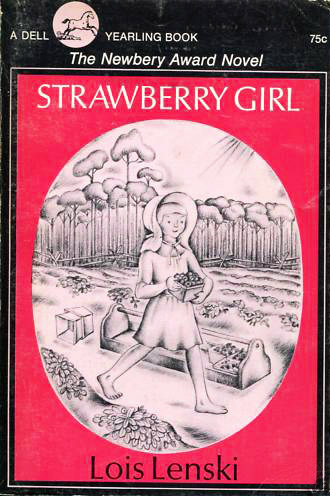
Strawberry Girl was the first novel I read by children’s book author and illustrator Lois Lenski (October 14, 1893 – September 11, 1974). I read the book in the fifth grade in secret, because with its pink cover, not to mention title, was girly. At the time, I was in the process of reading books that had the Newbery Award, regardless of content. There were some duds in that bunch. For instance, I could not get into Dr. Doolittle by Hugh Lofting, due to the archaic language and the fact that there was a stereotypical black character.
Strawberry Girl’s synopsis sounded girly, too. According to the back cover blurb, Birdie Boyer is a plucky ten-year old heroine in turn of the century Florida who oversees a crop of strawberries in the hopes of winning some Four H-styled prize. The actual story is somewhat darker. It’s about a Hatfield vs McCoyesque feud between the Boyer’s neighbors, who are in reality, squatters. The father, in particular, is a drunken lout with rage issues. The mother is not much better. The Boyers, by contrast, are one class above them, and while not educated, per se, have strong bourgeois values and a Puritan work ethic. The neighbors don’t resort to violence. Instead, they use criminal mischief, such as ignoring property boundaries and destroying crops. The neighbor’s son is the lone good egg in the family, and with the help of Birdie, tames his wild streak. The families enter into an uneasy truce, thanks to the friendship between the two kids. The story is accompanied by the author’s stark, black-and-white illustrations that have the austere quality of folk art.
I ended up reading other Lenski books that year. Her regional series followed the lives of children in various US locales. Most of the scenarios dealt with poverty in some form or another. Appalachia is explored in Blue Ridge Billy. Judy’s Journey is about migrant workers. She even dealt with racism in a book that I only heard about, entitled Mama Hattie’s Girl, which features an all-African American (or in the parlance of the time, Negro) cast. Yet another novel is set in San Francisco’s Chinatown. Lenski was prolific, writing and illustrating many picture books, historical novels and even songbooks. Her focus on poverty and effects on children make her a kind of children’s lit version of John Steinbeck.
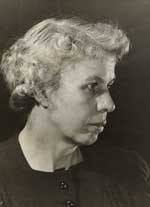
Lois Lenski
Much of her work is out of print. This past summer, I volunteered for my local library (MLK Public Library here in DC), and I had the pleasure of working with the Rare Children’s Book Collection. Many Lenski works are housed in there.
It’s a shame that more of her stuff isn’t in print. Her focus on the vulnerable left an impresseion my young mind, and made me empathetic and curious about the lives of others.








 Craig Laurance Gidney
You must be logged in to post a comment.