Author of "Sea, Swallow Me & Other Stories" (2008 Lambda Literary Finalist); "Skin Deep Magic" (2014 Lambda Literary Finalist); "Bereft" (2013 Bronze Moonbeam Award and 2014 Independent Publishers' Award) "The Nectar of Nightmares" (Dim Shores Chapbook) and A Spectral Hue (2019)
“The Fountains of Neptune” is a dream-like, dense anti-novel that uses dreams and myths to discuss the perception of history, memory, and loss. Like the novels of Jeanette Winterson, “Neptune” does not rely on standard plot structure. The basic story is two-fold: young Nicholas grows up in preWWI France, a precocious nine year old living a town of eccentric storytellers. A traumatic event causes him to go into a coma. He wakes up 50 years later, after both World Wars, having spent his life in dreams. The second part of the story concerns his relationship with his therapist, Dr. K, and her attempts to rebuild his memories. But it is Ducornet’s unlimited imagination and gift for fabulation that is the true star here. Her images are sharp, eerie, humorous — and always haunted. Ducornet leads us into the labyrinth of the subconsious — complete with its demons, half-heard conversations, and golden memories — but leaves no trail of twine or breadcrumbs to find our way out. Phantom ships, enchanted seascapes combined with idyllic countrysides and the philosophical world the Spa where Nicholas and Dr. K have their metaphysical relationship make this one labyrinth you won’t want to leave — Minotaurs or not.
Over on the Lambda Literary site, Michael Graves interviewed me along with a bunch of other writers about our first time doing a book signing. Check it out!
Me reading from “Sea, Swallow Me” at my book signing in 2008. Photo: Thomas Drymon
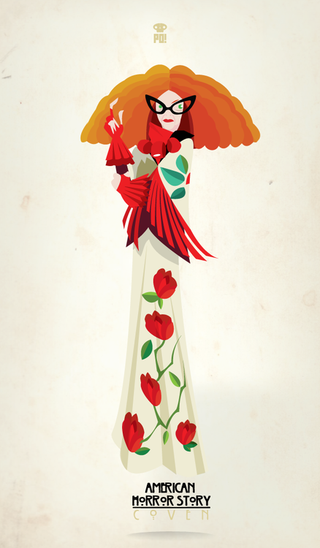
American Horror Story:Coven comes to an end tonight. It was a hot mess of season that just cohered into a bigger hot mess. Marie Laveau!The Axe Man!Madame LaLaurie!Stevie Nicks! It had bitchy catfights, necromancy and scenery-chewing turns by most of the actors involved. It played, inexpertly and ineptly, with issues of racism and misogyny, with provocative imagery that lead nowhere. The world-building was weak-sauce (is the Axe Man a ghost or not? Why is Voodoo different from witchcraft?). Characters were under utilized or disappeared entirely for no apparent reason. In short, the show suffered from lazy writing.
But.
It was addictive. The characters–completely over-the-top–were wonderfully created. And AHS:Coven is certainly will go down as one of the most campy programs on television. It had some amazing dialogue and one-liners, mostly delivered by the actor Frances Conroy, whose role as the eccentric Myrtle Snow was the secret weapon that barely held the show together.
Myrtle Snow is a character that will launch a thousand drag queens.
The talented and provocative Jim C. Hines posted a thread on his Facebook about increasing diversity at SFcons. The responses to that thread were for the most part positive about the issue, but, predictably, there were a few ‘trolls’ who raised the de rigueur whining about quotas, political correctness, and, most egregiously, the notion that ‘urban blacks’ don’t read, most of all, speculative fiction.
To that last claim: I live in a largely black city (Washington, DC) and I take public transportation. I can assure you: ‘urban blacks’ read. On buses and subways, a book-reading black person isn’t a Unicorn who only comes out during nights when the moon is blue. If someone is reading something I’ve read—and they aren’t completely tuned out to the world—I will say something to them. “Great book!” or “Have you read <insert name of author>?”
a unicorn who only comes out during nights when the moon is blue
Anyway, I don’t know what strategy would work to get a more diverse demographic to attend. (But I have some ideas—more about that in a later post). But I do know what will drive ethnic and sexual minorities away.
It’s not that cons are whites-only spaces, per se. Rather, they give off the vibe of Stuff White People Like. Stuff White People Like, in case you didn’t know, is (or was) a popular website that snarkily/ironically listed things that ‘code’ as White. Such as, “White people like paninis!” or nonprofit organizations or organic markets. I freely admit, the hipster-modulated joke that website is predicated on is lost to me. Again, I live in a largely black city (though the population dynamic is changing). Seeing black people eating paninis or working for nonprofit organizations or shopping at Whole Foods is just banal. But that isn’t enough to drive people away, in my opinion. A nuisance? Yes. But I and my fellow PoC are made of sterner stuff. That vibe, in my opinion, provides a fertile ground for both macro- and microagressions. It’s the subtle message ‘one of them is here?!!?’ that cause reactions that range from the overly enthusiastic to the downright hostile.
I’ll give some examples.
I was at a con a few years ago (which I won’t name) where my hair was touched and complimented on. The person who did it meant well, but you can’t but help feel like the Hottentot Venus when that happens. I believe the person came from the overly earnest school of liberalism where Othering, rather than meanness, is the form racial microagression takes.
More recently, at Arisia, there were reports of a white male walking into a party hosted by the Carl Brandon Society and informing the group there that slavery wasn’t all that bad. This, of course, is open hostility.
Both examples are unpleasant things that would make most people wonder about the value of spending an expensive weekend where you’re considered either a Token or an Intruder. I love Game of Thrones and China Mieville and Ursula LeGuin, but there are limits.
And here’s another thing. When a ‘troll’ shows up on a message board forum (or Facebook thread) and spews ignorant/hostile/covertly hostile garbage, the Abstract People of Color hordes they’re talking about? They use the Internet, too. They even read entire websites dedicated to Science Fiction/Fantasy/Horror. A 15 year-old me, reading stuff like ‘urban blacks don’t read SF’ would sooner go to a Daughters of the Confederacy cotillion than a SF convention. (The food would probably be better there, too.) Whitesplaining is another form of micro-aggression that will push someone away. There is a long and storied history of racism in the SF community that whitesplainers ignore or pretend doesn’t exist.
I am ending my temporary exile from convention-land by attending the 2014 World Fantasy Convention that will be in my own backyard—in DC. I want to bring my younger cousin to it, as well, since he has firm geek credentials. Maybe our presence will make other PoC feel less alone.
This short story could be in the New Yorker. The fantasy element is slight and serves to underscore this comedy-of-manners family saga. The story is grounded in reality and comes alive in the tensions between the siblings. Reminds me of the “mundane” magical realism of Jonathan Lethem, Jonathan Carroll or Karen Joy Fowler.
One of my pet peeves about literature is how the Universal Everyperson is always defaulted to white and male. Sartre and Camus are heralded as writers of the Existential Angst of Modern Man, while Ralph Ellison’s masterpiece Invisible Man is simplistically (imho) considered to just be about the Black Experience. I think that Invisible Man can be considered as much about Existentialism and anomie as much as The Strangeror Nausea.
I read Invisible Man in my late twenties and was struck at how it mirrored my own life. Like the nameless narrator, I was cast in the Exceptional Negro role, being a member of the Talented Tenth. I did not go to a HBCU, instead opting for a small college specializing in the Liberal Arts, where I was often the Face of Diversity. Like the narrator, I flirted with Marxism and dealt with Black Nationalism until I found a way to define myself away from any rigid ideology. I had to go underground—away from other people or influences—to finally figure who I was, and what my own idiosyncratic philosophy of life was.
Manuscript of the first page of ‘Invisible Man.’
The Black Experience in America is, in many ways, an existential quest, with the matter of race serving as the Absurdism of life.
Super Bass is a dense, ‘slice-of-life’ piece of fantasy fiction that’s also a love story. The prose is rich, sensual and deeply interior. It reminds of me of early Samuel R Delany, when he just throws you into an alien landscape and then challenges you to fill in the dots. The milleu has a vague Candomble feel, a lush tropical world where the gods inhabit/”possess” their chosen vessels, transforming them into supernatural healers. The story is about a consort to one of these god-vessels. Polyamory and same-gender relationships are the norm. The use of language reminds of me Kiini Ibura Salaam’s work.
“Love doesn’t take the burdens away, only makes them worth bearing.”
“A Good Man is Hard to Find” was my first introduction to the work of Flannery O’Connor, and short fiction in general. It really packs a wallop. Black comedy, serial killers, social critique and, ultimately metaphysical transcendence are all in this brief story. Her fiction is dense and multi-layered. There is more going on in them than entire novels. Of all of the writers of the Southern Gothic school, her work is the one that endures the most with me.
In her cosmology, G-d dwells in the darkest corner of the soul, and that is where He does his work.
It’s not just her acerbic wit or her finely drawn characters or her unmistakable sense-of-place. I think it’s because her fiction is tinged with a singular world-view that is just a wee bit over the edge. The subtext of her work is about Faith, particularly, the concept of the Lord’s Grace. But O’Connor’s Lord is not your grandmother’s Lord. In her cosmology, G-d dwells in the darkest corner of the soul, and that is where He does his work.
Many of O’Connor’s characters are terrible human beings. Openly racist, violence-prone, death obsessed, and narrow-minded. Though she was a devout Catholic, there is a streak of Gnostic theology in her work. Her characters worship the false God (the Demiurge), who created this flawed world (in her work, race relations simmer beneath the surface). The face (and Grace) of the true God is revealed to her grotesque characters in shocking ways.
I’m agnostic at best, but O’Connor’s fiction makes Christianity full of dark beauty and mystery.
“Cara’s mother had always said something very strange about dust: that it was the remains of the dead, and should be respected. “The air is full of other people,” she had told Cara. The dust in the sunlight looked like stars.”
The Warrior Who Carried Life is Geoff Ryman’s first novel, which has been reprinted by the Canadian Press Chizine. It’s a darkly mythic novel that combines the Epic of Gilgamesh with dashes of Celtic and Indian mythology.
A young woman whose family has been dishonored by invaders undertakes a vengeance-based quest to oust the evil from her land. To do so, she magically transforms herself into a male warrior who is nearly invincible. Along the way, she discovers the true nature of the invaders and her quest eventually leads her to the land of death. The novel is drenched in magic, not unlike Tanith Lee’sTales From the Flat Earth series—there are fabulous beasts, wise women, immortality, and miracles. TWWCL engages and subverts mythic tropes left and right, recalling Samuel R. Delany’s classic novel The Einstein Intersection. Despite the magical overlay, this is a brutal story, full of shocking violence.
Many of the tropes and themes that ballast Ryman’s oeuvre are here. The violence and war of the imaginary land shares a tenuous connection with other Ryman works that chronicle and examine the horrors faced by Kampuchea (Cambodia)—e.g., The Unconquered Country & The King’s Last Song. It is also a deeply feminist and genderqueer novel, with a transcendent lesbian love story at its spiritual center.
Once, I captured my inner child. I saw one her evening, crawling on the cornices and wandering on the edge of the wainscoting. At first I thought it was a figment of my imagination; after all, I was a wee bit tipsy on the Creme Yvette cocktail Aunt Sapphire had made before she turned in. But sure enough, there she was, a winged cherub, flitting amongst my curios and tchocktes. The nerve! Frankly, I was disappointed in the way she looked. She was so delicate and pale; I am made of much sterner stuff.
But the fragile schtick was a sham. She was a little monster. She spat in my heirloom Waterford crystal glasses. She knocked over my favorite Llardo figurine—the flamenco dancer awhirl with a blood-red hem on her white dress. When she began crawling on my replica of an Imperial Russian samovar, it was too much. I slammed down my highball glass, and knocked the nasty child into the belly of the samovar.
There, she sat for months.
At first, she banged on the gold-plated tin prison walls. But as time passed, her clanging changed to scratching, and the scratching turned to silence. When I finally opened the samovar to check on her, she was as still as a porcelain doll. When I picked her up, I felt an ice cold knife pierce my left side, just below my ribs. That place still aches now.
I keep her effigy in a a golden cage, in hopes that one day she will wake up.

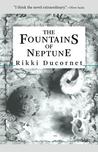 The Fountains of Neptune by Rikki Ducornet






 Craig Laurance Gidney
You must be logged in to post a comment.