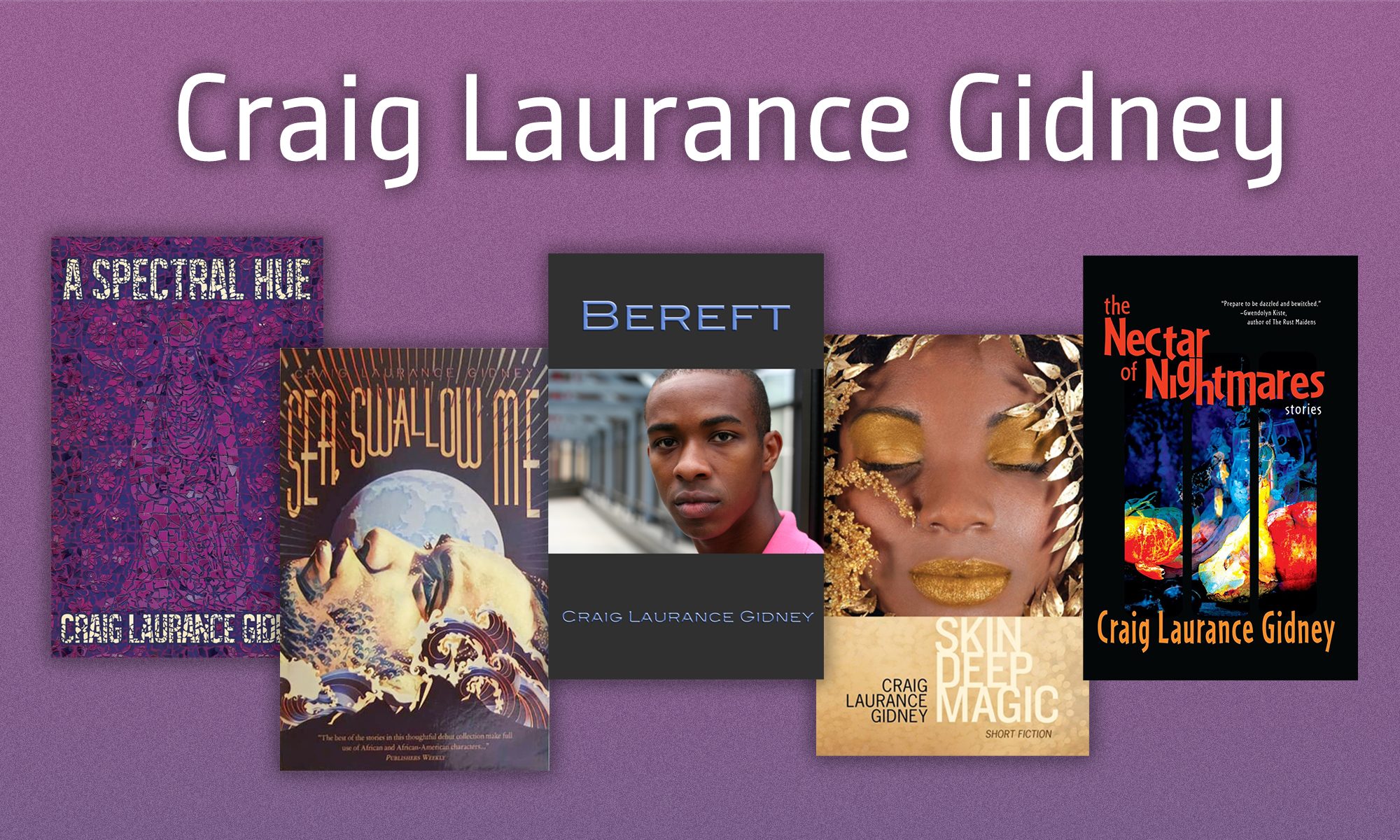
BEREFT is now available on Kindle!
My YA novel about homophobia, racism and bullying is not available on Kindle. I will announce it when the book become available on other E-reader formats.
BEREFT is now available on Kindle!
My YA novel about homophobia, racism and bullying is not available on Kindle. I will announce it when the book become available on other E-reader formats.
By day, Henry Darger was janitor. He’d had a hard life; he had been orphaned and raised in a Boy’s Home in Chicago. He spent his days doing menial work at a Catholic Hospital, and went home to a dank basement where he lived as a hermit. But in that basement, there existed another world, one that he created. Nights he created an imaginary world full of winged beings, child slaves and heroic princesses. He was writing a novel, an epic set on a magical world where good and evil clashed. This world was meticulously illustrated, with eerie murals created from paint and collage. He is considered to be the ultimate example of an Outsider Artist.

The intensity of his vision is admirable. It was a burning passion, almost a madness. Darger was compelled to write and illustrate thousands of pages of this story, with no intention to publish. His work was only discovered after his death. There are times when, as writer, you feel that you’re just writing for yourself. For Darger, that was enough.
I have a short piece of homoerotic fiction up at Wattpad. It was written for a cancelled anthology about queer punks. It’s set in London and features cameos by Siouxsie Sioux and Sid Vicious. Enjoy Join Hands

A great article about Authors of Color who write Speculative Ficton!
Here is my review of The Chaos, by Nalo Hopkinson, on Edi Campbell’s blog.
Title: The Chaos
Author: Nalo Hopkinson
Date: Margaret K. McElderry Books, 2012
Reviewer: Craig Laurance Gidney
In many ways, Sojourner “Scotch” is a typical teenager. She must navigate between her “good girl” persona when at home with her strict parents and her saucier persona at school, where she is a member of a hip hop dance crew. She has broken up with her boyfriend, and her (former) best friend is sniffing around him. And in many ways, Scotch’s problems are unique. She is the light-skinned daughter of a mixed race couple, so she has to deal with the “what are you?” questions all the time. Her older brother has just come back from juvie after being busted by her parents for having marijuana. And a couple more things: Scotch has a weird skin condition, where black, sticky splotches appear on her skin, and she’s been seeing floating horse heads swooping around…
View original post 414 more words

My story “Conjuring Shadows” was inspired by the Harlem Renaissance writer and artist Richard Bruce Nugent. As a writer, Nugent’s work was strongly influenced by modernism. It was highly elliptical and poetic. His most famous piece, “Smoke, Lilies and Jade” is a stream of consciousness mediation on art, racial and sexual identity. “Smoke, Lilies and Jade” is also a pioneering work of black gay writing. Nugent was also a painter and illustrator. His illustration work has the sinister eroticism of Cocteau’s scribbles, and the wicked decadence of Aubrey Beardsley, while his paintings are influenced by the Romantics. Like Oscar Wilde, Nugent also penned retold Biblical tales and myths. Nugent was also born in Washington, DC, like yours truly.

Whatever happened to Randall Kenan?
If you like magical realism, you must read his first, and to my knowledge, only published novel, A Visitation of Spirits. The book follows a young closeted black nerd (comic books are his obsession) named Horace. He wants to transform into a bird to escape the religious, homophobic community where he lives. He believes that his desire is the result of demonic possession. The novel chronicles a season in hell, to borrow Rimbaud’s phrase. Keenan’s prose soars and he uses all manner of narrative techniques to convey Horace’s interior emotional landscape. It’s what I would call an alchemical novel, one that transcends the limitations of realistic fiction to reveal greater truths. A Visitation of Spirits is a masterpiece of magical realism and belongs on the same shelf as Toni Morrison and Ben Okri. It is also a seminal work about black gay lives. Anyone who loves lush, surreal language should hunt down a copy!
I wish Kenan would write another book!
Black and white are the primary colors artist Kara Walker uses. Shadow and light. Negative and positive space. Her tableaux are made of black paper, and they are silhouetted against a gallery’s white walls The archetypical imagery she uses–sordid scenes from slavery. The wild-haired pickaninny, the scheming Southern Belle, the oblivious Good Master, the slave’s body in chains… Referents are classic children’s books, the mythology of the Antebellum South, and black memorabilia. It’s work that is never kitsch or twee; it’s dangerous and graceful at the same time.

Walker’s work dismantles the Master’s House with the master’s tool, to borrow a quote from Audre Lorde.
Blackface, the act and art of caricaturing African skins and features, is a practice that won’t die. It lives on in the fashion industry and advertising, where outrageous imagery and shock are important selling points. The figure of Black Pete in the Netherlands—Santa Claus’ slave—persists in their Christmas traditions, though many people say that Pete is “black” because of soot. In Britian, Golliwogs are beloved toys and many people are unaware that ‘gollys’ are slightly altered minstrel figures. Blackface, dolls, mammy figures—all serve to send the message of the undesirability and the alieness of the black body. Are we even human?

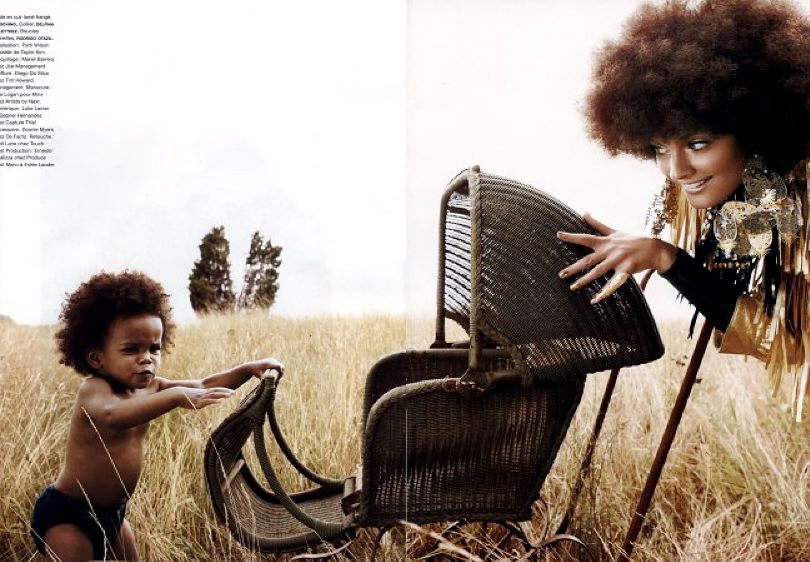
There are now several artists who have attempted to reclaim these racially charged images. The most controversial of these is the Swedish artist Makode Linde. His most (in)famous work was performative. A red velvet cake was formed into the shape of the Hottentot Venus and decorated with black fondant icing. The artist served as the grotesque cake’s head, and every time someone took a piece of the blood-red cake, he screamed.
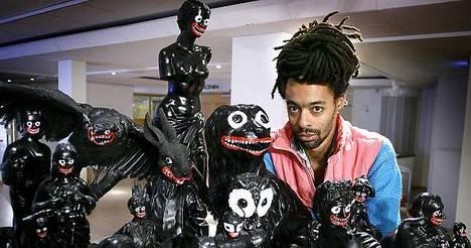
The purpose of this performance was to highlight the issue of female genital mutilation. It was lurid, and many critics thought it trivialized the plight of these young women, something I agree with. The piece was disturbing and problematic, but it was also confrontational. The cake was set up in an art gallery, and there are many pictures of well appointed white folk laughing at the horrific spectacle. I go back and forth about whether this work is the ultimate trollery or a multilayered thought-provoking piece.
I have checked out Linde’s other work, and it uses grotesque images of black faces and juxtaposes them in European settings. In one, Queen Elizabeth (the current one) stands next to a man defaced with Golliwog-like features. The same face appears on the head of a classical Greek statue. What draws me in also chases me away. Here, Linde’s work is more slightly nuanced. It is still very unsettling and has the subtlety of a Julie Traymor production.
I play with black grotesques and archetypes in my own work; I think what I do with them is less ambiguous than Linde’s work. For instance, my story “Catch Him By The Toe” riffs on the Sambo story. These horrible images, archetypes, tropes and stories are a part of our heritage. If the fashion industry can use them, we have a right to use them as well.


 Craig Laurance Gidney
You must be logged in to post a comment.