Podcast: The Outer Dark panel discussion at NecronomiCon is now up!

Outer Dark Providence

The Outer Dark panel discussion at NecronomiCon is now available for your listening pleasure at This Is Horror.

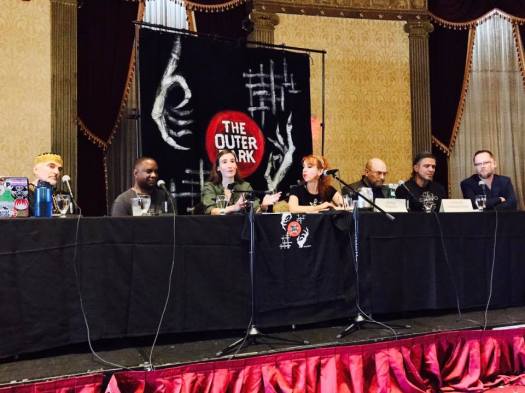
The Outer Dark presents an all-new panel discussion recorded at NecronomiCon 2017 featuring Craig Laurance Gidney, Scott R. Jones, Stephen Graham Jones, Peter Straub and Sonya Taaffe. hosted by Scott Nicolay and moderated by Anya Martin (00:18:25). The discussion focuses on long term trends in Weird fiction including living in Weird sociopolitical times, the growth of the Weird Renaissance and its effect on the greater Literature Fantastica, new Weird visions by marginalized voices, destabilization versus reassurance/escapism, ‘reality as a trampoline,’ Weird fiction’s conservative past versus a different kind of Weird story emerging now, Lovecraft’s anxieties as a ‘window’ onto a much larger horrifying world, ‘new’ voices challenging our concept of what is The Weird, embracing versus rejecting fear and loving Otherness, altered market forces and the effect of editorial shifts and the rise of the small press, why speculative fiction should be interstitial, writing ‘things we don’t know,’ less explored topics in Weird fiction, and some exciting announcements about the future of The Outer Dark. This panel took place on Saturday August 19 at noon.

Link: Lovecraft’s Legacy by Paul St. John Macintosh

Over at Greydogtales, a weird fiction blog, author/critic Paul St. John Macinktosh has an essay that examines the latest kerfuffle in the weird fiction community. (Lovecraft’s racism and the legacy of his fiction in many ways mirrors the current culture war over Civil War monuments). In the essay, he highlights POC writers (N.K. Jemisin, Victor Lavalle) who subvert/revise/challenge the subtextual xenophobia in HPL’s work in addition to calling out the denialism/minimizing that many aficionados use.

If there was a huge racial component to Lovecraft’s definition of “unknown,” then you could almost read into such remarks a frustrated longing to engage with other unknown peoples, as much as fear and distaste towards them. That’s as plausible an interpretation as any claim that Lovecraft’s mature work is some kind of systematic dog-whistling for underlying racism, with Deep Ones and ocean-going cultists standing in for black Americans and Catholic immigrants.

Link: Lovecraft’s Legacy

EVENTS: I’ll be at OutWrite next weekend!

I will be at Outwrite, the LGBT Book Festival in DC, next weekend. I’ll be reading/on panels with some really cool folks. My schedule is below.

outwrite-1-e1485928621601

Saturday August 5
Of Love & Other Monsters – 12pm – 1pm
A Speculative Fiction Reading featuring Craig L. Gidney, Steve Berman, Rahul Kanakia & Ruthanna Emrys. Moderated by Michael Thomas Ford.

Saturday August 5
Beyond Binary – 4pm – 5pm
A panel on gender in speculative fiction moderated by Don Sakers. Featuring panelists Craig Gidney, Rahul Kanakia, Ruthanna Emrys and Michael M Jones.


Last night’s event: OutWrite’s “The Future Is Queer.”

It was a pleasure to share the stage with authors Day Al-Mohamed, Sunny Moraine, & Sarah Pinsker. Thanks to OutWrite, East City Books and moderator Marianne Kirby. And a special thanks to those who came to hear us read.

I read from the first section of THE NECTAR OF NIGHTMARES.

On “Moonlight”: in praise of blue black boys

I finally saw the movie “Moonlight” over the holidays. I am pleased that it was nominated for 8 Academy Awards. Adapted from the play “In Moonlight, Black Boys Look Blue,” the film is, among other things, a coming-out story of a young black man, set against the backdrop of the 1980s war on drugs. It’s a sparse film, full of small gestures and precise performances. The main character is seamlessly played by three actors, from prepubescence to young adulthood.

mv5bnzqxntiyodaxmv5bml5banbnxkftztgwnzqymda3ote-_v1_sy1000_cr006741000_al__9faf4b52dbddeb9ba077e32011e01749-nbcnews-ux-600-700

The resonance between my 2013 YA novel BEREFT and the film is very strong. Like the character Chiron in Moonlight, my 13-year old character Rafe faces bullying and lives with his mentally unstable mother in an inner city neighborhood. (BEREFT differs in that it focuses on Rafe’s school life when he gets a scholarship to a Catholic prep school).

The importance of the movie, which centers on black queer love, cannot be overstated.
Our stories are finally getting the recognition they deserve.