REVIEW: Cruel Pink by Tanith Lee. #tanithlee #immanionpress

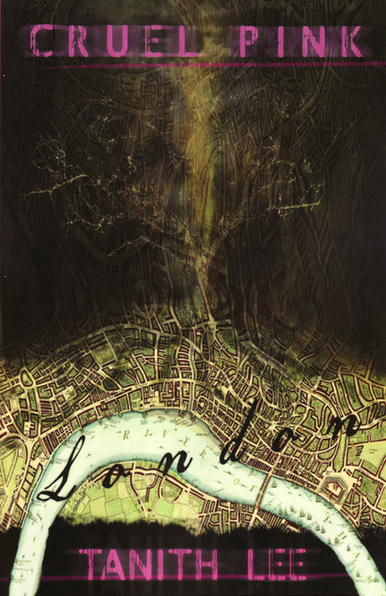
Cruel Pink is the sixth book in Tanith Lee’s loosely configured Colouring Book Series. All of the previous books in this series explore both odd psychology and odd situations in mostly realistic settings. The stories can, and do leap into the paranormal, but that isn’t their focus. The theme of color, often in lurid hues, is the overarching motif of the series. The books share a distant kinship with other liminal and cross-genre writers like Chuck Palahniuk and Jonathan Carroll. Elements of crime fiction, ghost story, horror story and even metafictional conceits all parade through the narratives.

Cruel Pink might be the strangest of the books so far. The novel is a symphony of voices across various times, a style most recently and famously used by David Mitchell in his Cloud Atlas and Ghostwritten novels. The cast includes Emenie, a serial killer who lives in a post-apocalyptic future; Rod, an office worker in contemporary times; Klova, a young party girl living in a future society; and Irvin, a bisexual actor in the late 1700s. Each tells his or her story in conversational first person, and follows a day or a week in their lives.
cruel_pink

(Mild Spoiler)

As the novel progresses, coincidences begin to appear. It becomes quickly obvious that all four personae live in the same house just outside of London, but in separate times. And every now and then, they catch brief, ghostly echoes with each other. Also, the color pink in some form appears in each of their lives.

The book has ‘mood whiplash,’ like the Mitchell novels. Emenie’s sections are suspenseful and full of horror. Rod’s pieces are full of contemporary anomie. Klova ’s monologues describe a glittering semi-utopia and have erotic undertones, while Irvin’s life is full of ribald anecdotes.

The final denouement slots into place, courting but never becoming outright bathos. Cruel Pink, in the end, examines, almost playfully, narrative conventions in genre, flirting with both parody and homage.

Cruel Pink is compulsively readable and full of Lee’s trademark lovely language.

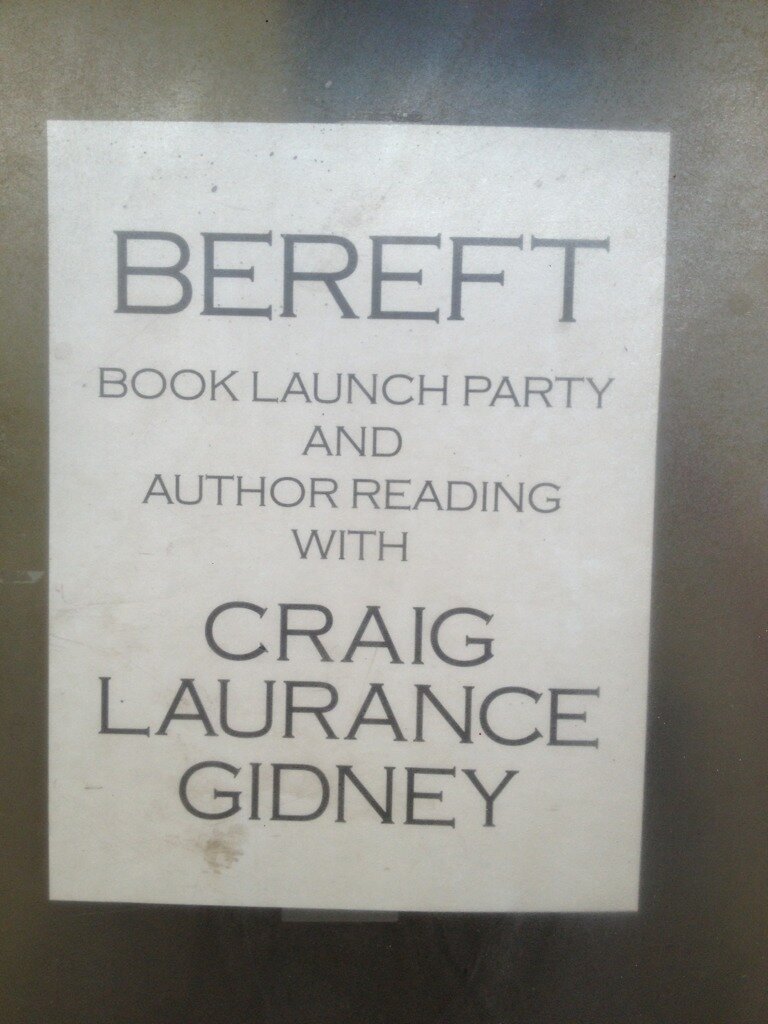
Craig Laurance Gidney and Lisa Nelson reading in Philadelphia on April 6

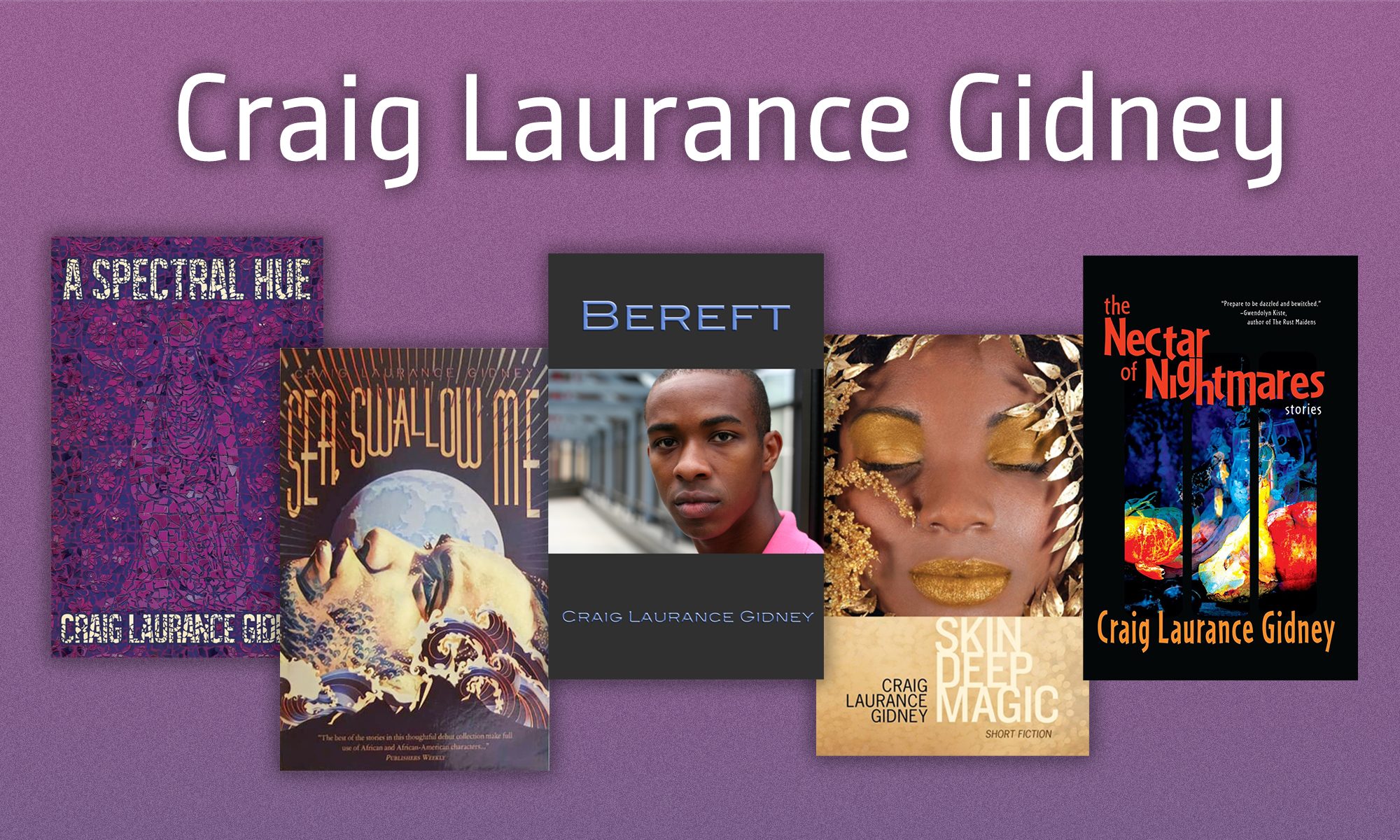
Craig Laurance Gidney and Lisa Nelson are the authors respectively of Bereft and Drifting (both published by Philadelphia’s own Tiny Satchel Press, each is $9.95 pb).

Craig Gidney’s new book from us is Bereft, which is about a young black gay kid and then there’s Lisa Nelson’s new book, Drifting, which is about a young girl who was taken away from her birth family

The reading will take place at Giovanni’s Room on April 6, 2012 at 5:30 PM.

Location:
345 S 12th St
Philadelphia
Pennsylvania
19107-5907
United States

Bereft is now out!

My short YA novel is now out, a week early. I’m excited and nervous at the same. If you do read the book, please review it. It’s available at all the usual venues, and a Kindle/Nook version will be coming along shortly (and will be announced when it does).  Thanks for your support!


Bereft_4x6_postcard_front

(Promotional postcard attached).

Author copies of BEREFT have arrived

photo

They look so new and shiny!

The cover was designed by Christopher Bauer and the photograph was done by Dan Brandenburg. I am so pleased the cover shows a young black man–so many YA book covers are “whitewashed.”

The official release date is February 26, 2013 and a release party is being planned in DC on the date of March 3.

Spread the word far and wide. If you know of venues for promotions–book clubs, blogs, schools, libraries–please do not hesitate to contact me with your ideas.

REVIEW: The Devil in Silver by Victor LaValle

Pepper is a working class furniture mover who, through an act of misguided gallantry, and the laziness of the a trio police officers, gets thrown into a psychiatric unit in Queens. What is initially supposed to be a 72-hour hold turns into a months long stay, due to bureaucratic incompetence and Pepper’s foolish decisions (a failed escape attempt among other mistakes). After being drugged and reprimanded, Pepper finally acclimates himself to the ward, he meets his fellow patients/prisoners and learns their back stories. Loochie (or Lucretia), the nineteen-year bipolar young woman who’s been in and out of hospitals for most of her adolescence and has a wild temper and can kick ass if need be. Dorry, an old white woman who’s been in the ward for decades and is full of wisdom. And Coffee, a Ugandan refugee who is obsessed with contacting the president and letting the world know about the miserable conditions at the New Hyde psychiatric unit.

Image

And miserable the conditions are. The building is in need of repair, there’s a rodent problem, the administrators are overworked,  and code violations are routinely broken. Finally, there is a violent patient, whom the patients call the Devil, who picks them off one by one. The staff seems to be in some conspiracy with the Devil, and steadfastly refuses to do anything significant to stop the murders.

If all of this sounds grim and depressing, it’s not. Humor—sometimes gallows and sometime Keystone Cops like—suffuses the text. There’s suspense, yes, but it’s also backed up by mordant social commentary about the state of public mental health and touching back stories for all of the characters—including various staff members. LaValle has created a horror story, a Swiftian satire, and a black comedy of errors in one story. Imagine Colson Whitehead writing One Who Flew Over The Cuckoo’s Nest and you have some idea of The Devil In Silver. It’s a powerful novel, and I want to read more LaValle!

The Next Big Thing Blog Hop.

Image

What is the [working] title of your next book?

 BEREFT

Where did the idea come from for the book?

 The book is an expansion of a short story I wrote for an anthology called FROM WHERE WE SIT: Black Writers Write Black Youth. The story deals the psychological effects of bullying and being in the closet and racism. So, in a way, the ‘idea’ of the book came from me re-visiting my 14 year old self.

 What genre does your book fall under?

 Realistic Young Adult Fiction.

What actors would you choose to play the part of your characters in a movie rendition?

 Hmmm. Maybe Jaden Smith for the lead character.

What is the one-sentence synopsis of your book?

 14 Year Old Rafael Fannen wins a minority scholarship to Our Lady of the Woods school, where he must deal with bullies, racism and homophobia.

Will your book be self-published or represented by an agency?

 The book will be published by Tiny Satchel Press this January!

How long did it take you to write the first draft of the manuscript?

 8 Months

What other books would you compare this story to within your genre?

 I would compare it to Yukio Mishima’s Confessions of A Mask and James Baldwin’s coming of age fiction.

What else about the book might pique the reader’s interest?

 People who read genre fiction will like that my hero, Rafael, is a book nerd, and compares everything to the various fantasy books he’s read. Inside references to Game of Thrones series and the Narnia books abound.

Please check out the other folks who tagged me.

 M.E. Burroughs

Catherine Lundoff

REVIEW: The Best of All Possible Worlds by Karen Lord (Spoiler Free)

A successful Science Fiction romance is a difficult thing to achieve. Part of it has to do with SF fans not wanting the romance part to interfere with scientific extrapolation. (In my experience, Romance readers are far more catholic in their tastes). The potential for camp (I’m thinking of Jacqueline Sussan’s Yargo), and the marketing of such a book add yet more layers.

 Image

Karen Lord’s second novel is completely different from her debut, the excellent retold/remixed Senegalese folktale Redemption in Indigo. It’s a love story hidden in and around a LeGuin-style anthropological quest/planetary travelogue novel. Mostly narrated in the first person by the vivacious and chatty government biotechnician Grace Delarua (with lots of clever asides and some exclamation points), The Best of All Possible Worlds follows the fate of the stoic, telepathic Sadiri, who have been relocated to Cygnus Beta after a viscous and unprecedented massacre on their home planet. Cygnus Beta is a sort of galactic dumping ground for orphans of the three strains of humanity (the Sadiri, the Ntshune, and the Zhinuvians). As such, there are trace elements of all cultures seeded and hidden in the large planet. Since the Sadiri population has been mostly decimated, they feel that they have to build up their population. Grace is assigned to assist the Sadiri in their quest to find suitable cultures and mates on Cygnus Beta.


Grace’s main contact is Dllenahkh, who is the de facto leader of the mission, which mostly consists of visiting various settlements and cultures on the planet, and doing genetic testing. In this sense, Lord’s novel is almost a ‘mundane,’ or slice-of-life SF novel. There are no superheros or monsters, and the book has a leisurely, episodic pace—kind of like life. Because of that, Lord mostly focuses on the bizarre and intriguing chemistry between the impulsive Grace and the inscrutable Dllenahkh. Dllenahkh is neither a brooding hero or a Spock-like ascetic. He is a believable alien with odd flashes of recognizable human behavior that seem to surprise even himself.


Plotwise, there are a lot of incidences and strange, ‘sense-of-wonder’ set pieces, which I won’t spoil. They aren’t just there for window-dressing for the Grace-Dllenahkh love story; various ethical issues are addressed, from the issue of ‘cultural purity’ to religion, to the issues around telepathy and privacy. (Because of this, the plot does tend to meander). Additionally, Lord does through a bone or two to techno-fetishists—with shades of Iain M. Banks Culture novels. But The Best of All Possible Worlds is ultimately a relationship novel. No, it’s not a Nicholas Sparks novel set in a far future; imagine Jane Austen at her most psychologically astute as written by Ursula LeGuin at her most cerebral.